
Last Updated : 2026-10-14
A cable joint is one of the few parts of a power distribution network that must be assembled in the field and may then remain inaccessible for years. Underground feeders, substations, factories and infrastructure projects rely on cable joints to maintain safe electrical continuity under changing loads and site conditions. Choosing the right power cable jointing kit is therefore an engineering decision—not simply a comparison of price per kit.
Al Yamuna Densons Industries (AYDI), based in Ras Al Khaimah, UAE, manufactures and supplies cable accessories for utility, EPC and industrial applications. Drawing on the group’s published heritage of more than 50 years in cable accessories, AYDI offers heat shrink, cold shrink and pre-moulded solutions, with technical support for project-specific selection.
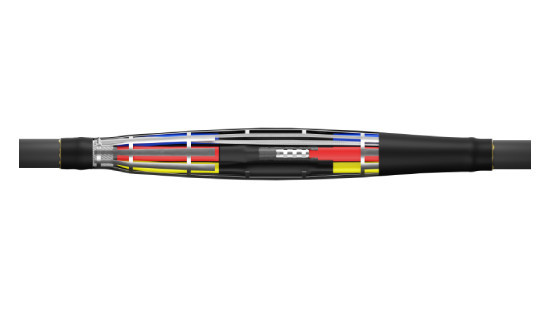
A straight-through joint connects prepared cable ends and restores the functions interrupted when the cable is cut. Depending on the cable construction, these include conductor continuity; primary insulation; electrical stress control at the semiconductor screen cutbacks; metallic-screen or earth continuity; and environmental and mechanical protection appropriate for burial or the intended installation. A joint is a system: the connector, insulation layers, screen treatment, seal and installation method must all work together.
The joint does not automatically recreate every original mechanical property of the factory-made cable. The selected joint must instead meet the electrical, thermal and installation requirements of the complete cable system.
TechnologyHow it is installedSelection considerationsHeat shrinkSpecially formulated components recover under controlled heating.Well-established utility technology; requires suitable heat equipment, workmanship and hot-work controls.Cold shrinkPre-expanded elastomeric components recover after the support core is removed.No installation torch for the shrink component; precise size compatibility and cable preparation remain essential.Pre-mouldedFactory-formed elastomeric insulation/stress-control body assembled over prepared cable.Controlled component geometry; insulation diameter, interference fit and installation procedure are critical.
No option is universally superior. A large utility rollout may value repeatability and crew familiarity; a petrochemical facility may restrict hot work; a specific cable construction may only be covered by certain verified kit designs. Cold shrink installation without a flame does not by itself make an accessory certified for explosive or hazardous atmospheres. Site permits, equipment classification and the complete installation method still apply.
Start with the complete cable voltage designation U?/U (Um), rather than referring only to “11kV” or “33kV”. Next identify whether the cable is single-core or three-core, copper or aluminium, XLPE or EPR insulated, armoured or unarmoured, and the exact conductor and insulation diameters. Screen design and earth continuity requirements are equally important.
Information to supplyWhy it mattersRated voltage U?/U (Um)Sets the relevant insulation and electrical performance class.Conductor material and cross-section (mm²)Determines suitable crimp or mechanical connector and current-carrying interface.Insulation type and measured diameterDetermines compatibility with insulation and stress-control components.Single-/three-core, metallic screen and armourDetermines breakout, screen continuity and earthing accessories.Direct buried, duct, tunnel or industrial siteInforms sealing, protection, installation access and work permits.
AYDI’s published pre-moulded joint portfolio includes 12kV, 24kV and 36kV product categories for single-core and three-core XLPE/EPR cable. Exact product availability, cable size coverage and qualifications should be checked against the applicable current catalogue and controlled datasheet before a quotation is issued.
The conductor joint must remain electrically and mechanically reliable during load cycles and applicable fault conditions. Whether a design uses a mechanical shear-head connector or a compression ferrule, verify its material compatibility, cross-sectional range, preparation and torque or crimping procedure. IEC 61238-1-3 addresses test requirements for mechanical connectors within its scope; connector compliance must not be confused with type testing of the complete cable joint.
Projects in Saudi Arabia, the UAE, Oman, Kuwait, Qatar and Bahrain may involve elevated ambient temperatures, saline conditions near coastlines, variable ground moisture and restricted work areas. For buried joints, correct sealing and cable preparation matter more than generic claims that a product is “weatherproof”. For industrial projects, confirm available working space, environmental exposure, permit requirements and the consequences of a feeder outage.
Installation workmanship is integral to performance. Correct insulation stripping dimensions, clean interfaces, screened-cable preparation, conductor connection, stress-control positioning and sealing are essential even when the kit is fully rated for the application.
For applicable medium-voltage extruded-insulation cable accessories, IEC 60502-4:2023 defines type-test requirements within its stated scope up to Um = 36kV, while HD 629.1 S3:2019 covers relevant accessory requirements up to Um = 42kV. The test methods are referenced in IEC/EN 61442. Low-voltage accessories and conductor connectors may require different applicable standards. The project specification determines which standard, edition and sequence are needed.
A strong technical submittal contains a controlled datasheet, installation instructions, the tested configuration and a complete applicable report that can be matched to the offered product. A standard appearing in an article is not evidence that all AYDI products or sizes have completed that test. Utility approval is similarly product- and authority-specific.
AYDI combines a UAE manufacturing and distribution base with a published product portfolio covering heat shrink, cold shrink and pre-moulded accessories. More than 50 years of group industry heritage and experience with product type tested at the best labs like KEMA and DEKRA, supplying regional power infrastructure. For an EPC or utility buyer, the practical advantage is coordinated selection of the joint technology, cable dimensional range, conductor connection and associated technical submission from a specialist cable-accessory supplier with support of jointer training program which is in-house, with this except Short-circuit all critical tests like AC high voltage, partial discharge, air and water heat cycle, polymer analysis are done in-house before we send any samples to any of our customers.
For 11kV or 33kV projects, AYDI’s team can review cable drawings and help identify a suitable kit configuration and the documentation needed for technical assessment. Specific third-party certification, utility approvals and customer references should be provided from the relevant verified records on request.
Send AYDI the cable datasheet, voltage U?/U (Um), conductor material and size, insulation diameter, number of cores, metallic-screen and armour details, site conditions and required quantities. Ask for the matching technical datasheet, installation instructions and available applicable type-test evidence together with the commercial quotation.
Have a question, idea, or requirement? Drop us a message and our team will get back to you with clear answers no fluff, no delay.